GL Journals
Description:
GL batches and journals report, including amounts and attachments
Parameters
Ledger, Ledger Category, Period, Period From, Period To, Posted Date From, Posted Date To, Creation Date From, Creation Date To, Created By, Journal Source, Journal Category, Posting Status, Funds Status, Exclude SLA Journals, Batch, Journal, Currency, Show Journal Line DFF Attributes, Show Attachment Details, Balance Type, Budget Name, Encumbrance Type, Reference, Concatenated Segments, GL_SEGMENT1, GL_SEGMENT1 From, GL_SEGMENT1 To, GL_SEGMENT2, GL_SEGMENT2 From, GL_SEGMENT2 To, GL_SEGMENT3, GL_SEGMENT3 From, GL_SEGMENT3 To, GL_SEGMENT4, GL_SEGMENT4 From, GL_SEGMENT4 To, GL_SEGMENT5, GL_SEGMENT5 From, GL_SEGMENT5 To, GL_SEGMENT6, GL_SEGMENT6 From, GL_SEGMENT6 To, GL_SEGMENT7, GL_SEGMENT7 From, GL_SEGMENT7 To, GL_SEGMENT8, GL_SEGMENT8 From, GL_SEGMENT8 To, GL_SEGMENT9, GL_SEGMENT9 From, GL_SEGMENT9 To, GL_SEGMENT10, GL_SEGMENT10 From, GL_SEGMENT10 To
Used tables
gl_code_combinations_kfv, per_people_f, gl_je_sources_vl, gl_je_categories_vl, gl_budget_versions, gl_encumbrance_types, gl_daily_conversion_types, gl_je_headers, gl_system_usages, zx_rates_b, gl_ledgers, gl_periods, gl_je_batches, gl_je_lines, gl_je_lines_recon, gcck, fnd_attached_documents, fnd_documents, fnd_documents_tl, fnd_document_datatypes, fnd_document_categories_vl, fnd_lobs, fnd_documents_short_text, fnd_documents_long_text
Categories
Related reports
Dependencies
If you would like to try one of these Oracle EBS SQLs without having Blitz Report installed, note that some of the reports require functions from utility package xxen_util.
Example Report
GL Journals 30-Apr-2021 220634.xlsx
Report SQL
www.enginatics.com/reports/gl-journals/
Blitz Report™ import options
Case Study & Technical Analysis: GL Journals
Executive Summary
The GL Journals report is the backbone of financial auditing and analysis in Oracle General Ledger. It provides a granular view of all journal entries—whether manual, imported, or generated by subledgers. This report is indispensable for Controllers and Auditors to verify the accuracy of financial statements, investigate account anomalies, and ensure strict adherence to internal controls.
Business Challenge
The General Ledger is the final repository for all financial transactions. However, analyzing this data can be challenging due to:
- Volume: Millions of journal lines make it difficult to find specific transactions using standard forms.
- Source Traceability: Determining the origin of a journal (e.g., “Did this come from Payables or Inventory?”) often requires navigating multiple screens.
- Compliance Audits: Auditors frequently request lists of manual journals, unposted entries, or journals created by specific users to test for segregation of duties.
- Reconciliation: Identifying the specific journal lines that make up a GL account balance is often a manual, error-prone process.
The Solution
This report solves these challenges by offering a powerful, parameter-driven “Operational View” of the General Ledger.
- Comprehensive Filtering: Users can slice data by Period, Source, Category, Status, and specific Account Segments to isolate exactly what they need.
- Full Audit Trail: Displays the “Who, What, When, and Why” of every journal, including the Creator, Approval Status, and Posting Date.
- Subledger Visibility: By including “Reference” and “Description” fields, it helps link GL entries back to their operational source.
Technical Architecture (High Level)
The report queries the core GL transaction tables, optimized for the star-schema design of Oracle GL.
- Primary Tables:
GL_JE_BATCHES: The container for journals, holding control totals and approval status.GL_JE_HEADERS: The journal entry header, defining the Category, Source, and Currency.GL_JE_LINES: The individual debit and credit lines.GL_CODE_COMBINATIONS_KFV: The Chart of Accounts structure.GL_LEDGERS&GL_PERIODS: Provides the accounting context.
- Logical Relationships: The report follows the standard hierarchy: Batch -> Header -> Line. It joins to the Code Combinations table to resolve the accounting flexfield segments (Company, Department, Account, etc.) into readable values.
Parameters & Filtering
- Posting Status: Critical for month-end close. Allows users to find ‘Unposted’ or ‘Error’ journals that are holding up the close process.
- Source & Category: Enables targeted analysis (e.g., “Show me all ‘Manual’ journals” or “Show me all ‘Accrual’ entries”).
- Account Segments (GL_SEGMENT1…10): Allows for precise account analysis (e.g., “Show all journals hitting the ‘Travel Expense’ account in the ‘Sales’ department”).
- Exclude SLA Journals: A performance and usability feature. Since Subledger Accounting (SLA) generates massive volumes of detailed journals, excluding them allows for a cleaner view of manual and summary-level entries.
Performance & Optimization
- Partition Pruning: By filtering on
GL_LEDGERSandGL_PERIODS, the query takes advantage of Oracle’s standard partitioning strategies for GL tables. - Selective Columns: The report allows users to toggle “Show Journal Line DFF Attributes” and “Show Attachment Details,” preventing unnecessary data retrieval when not needed.
FAQ
Q: How can I find all manual journal entries created last month? A: Set the “Period” to last month and the “Journal Source” parameter to ‘Manual’.
Q: Does this report show the foreign currency amounts? A: Yes, the report displays both the “Entered” (foreign) currency amounts and the “Accounted” (functional) currency amounts, along with the conversion rate used.
Q: Why can’t I see the subledger transaction details (e.g., Invoice Number) here?
A: This report shows the GL view. While some references are carried over to GL_JE_LINES.REFERENCE_1, detailed subledger data is best viewed in the “GL Account Analysis (Drilldown)” report or specific subledger reports.
Oracle E-Business Suite Reporting Library
We provide an open source Oracle EBS SQLs as a part of operational and project implementation support toolkits for rapid Excel reports generation.
Blitz Report™ is based on Oracle EBS forms technology, and hence requires minimal training. There are no data or performance limitations since the output files are created directly from the database without going through intermediate file formats such as XML.
Blitz Report can be used as BI Publisher and Oracle Discoverer replacement tool. Standard Oracle BI Publisher and Discoverer reports can also be imported into Blitz Report for immediate output to Excel. Typically, reports can be created and version tracked within hours instead of days. The concurrent request output automatically opens upon completion without the need for re-formatting.
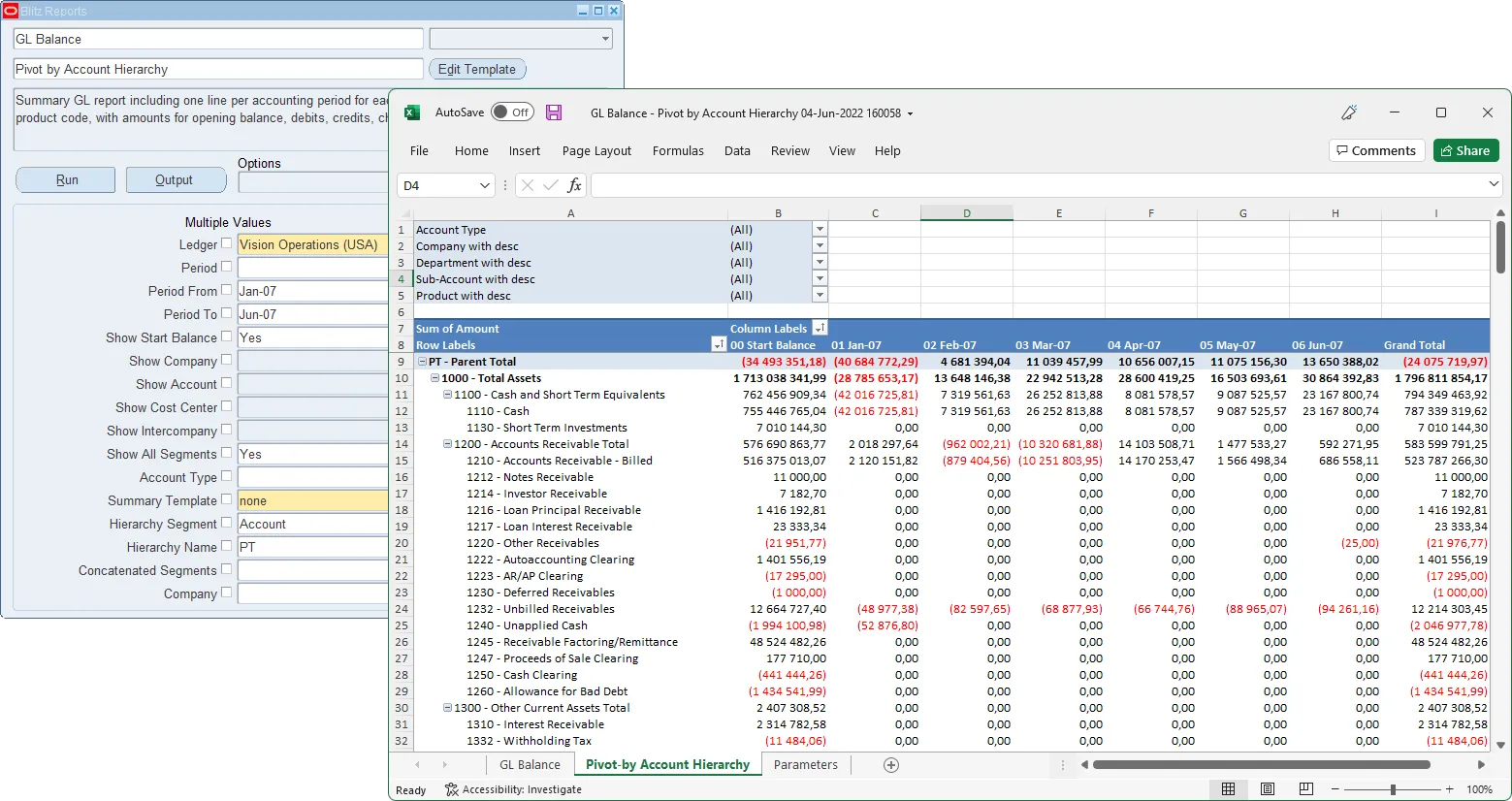
The Filters, Columns, Rows and Values fields are used to create and deliver the data in pivot table format with full drill down to details.
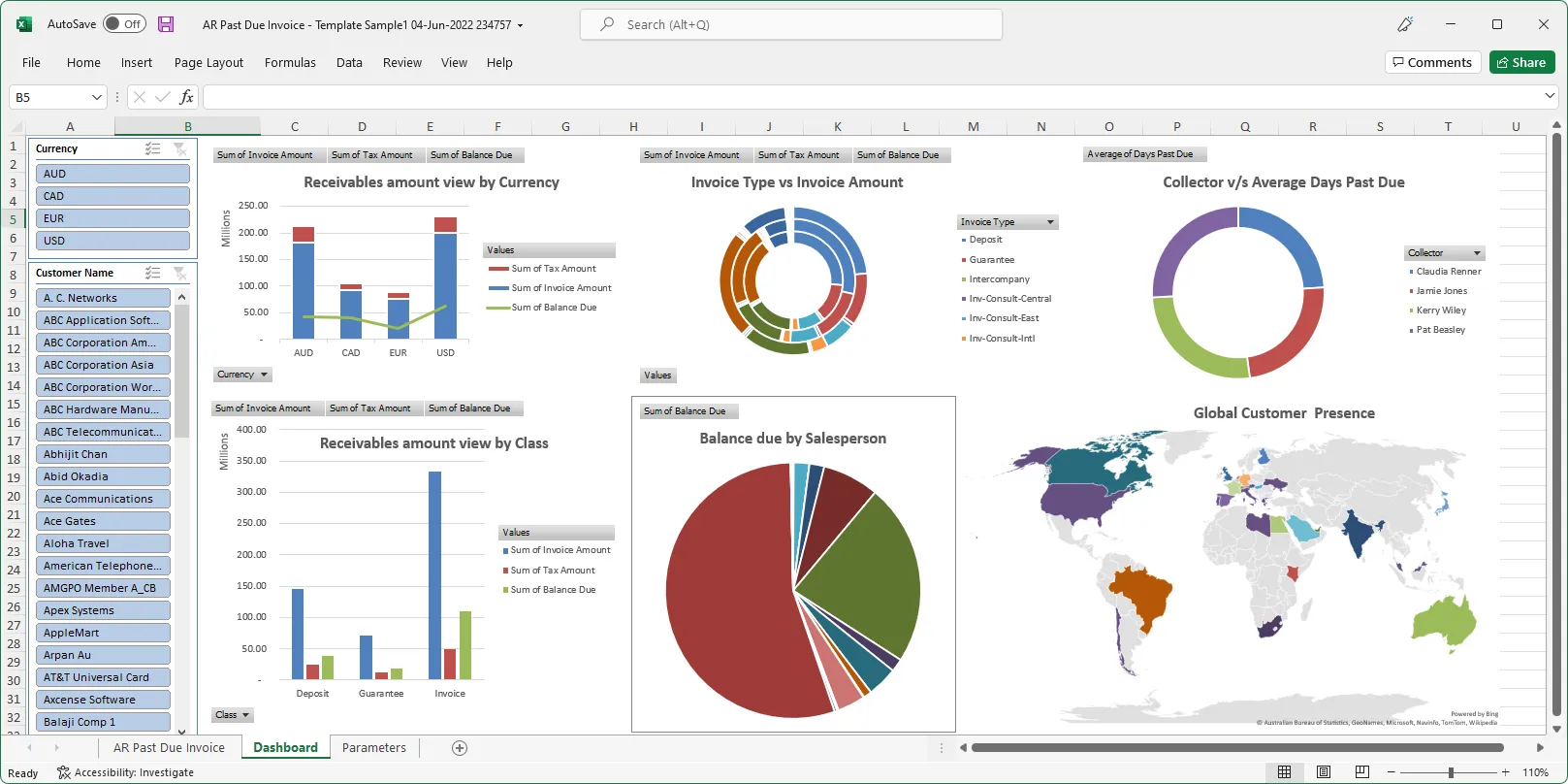
The Excel template upload functionality in Blitz Report allows users to create their own layouts by uploading an Excel template with additional sheets and charts, automatically refreshed when the report runs again. This allows to create custom dashboards and more advanced visualizations of report data.
You can download and use Blitz Report free of charge for your first 30 reports.
The installation and implementation process usually takes less than 1 hour; you can refer to our installation and user guides for specific details.
If you would like to optimize your Oracle EBS implementation and or operational reporting you can visit www.enginatics.com to review great ideas and example usage in blog. Or why not try for yourself in our demo environment.
Useful Links
Blitz Report™ – World’s fastest data upload and reporting for Oracle EBS
Oracle Discoverer replacement – importing worksheets into Blitz Report™
Blitz Report™ Questions & Answers
Supply Chain Hub by Blitz Report™
© 2025 Enginatics